Dataset Structure
RealSim-CP is organized as a hierarchy: scenarios → weather/time variants → agents → sensor streams, with one OpenLABEL annotation file per variant.
flowchart LR
  dataset["RealSim-CP dataset"]
  dataset --> scenarios["Scenarios<br/>Daiba Station, Shutoko, Aomi Crossing"]
  scenarios --> variants["Variants<br/>sunny / night / rainy<br/>~10 s at 10 Hz"]
  variants --> agents["Agents<br/>vehicles + RSUs"]
  agents --> cameras["Camera streams<br/>PNG image sequences"]
  agents --> lidars["LiDAR streams<br/>PCD point clouds"]
  variants --> labels["label_OpenLABEL_style.json"]
  labels --> calib["Calibration<br/>intrinsics + extrinsics"]
  labels --> poses["Per-frame poses<br/>scene → agent frames"]
  labels --> objects["3D object annotations<br/>cuboids + classes"]
Per-variant folder layout
Every scene variant has the same on-disk layout:
<variant>/
├── images/
│   └── <agent_id>/
│       └── <camera_id>/
│           └── image_000000.png ... image_010000.png
├── point_clouds/
│   └── <agent_id>/
│       └── <lidar_id>/
│           └── velodyne_vlp_128/
│               └── point_cloud_0.pcd ... point_cloud_100.pcd
└── label_OpenLABEL_style.json
<agent_id>is eitherrsu_<n>(a static road-side unit) orvehicle_<n>(a moving connected vehicle).<camera_id>/<lidar_id>are globally unique sensor IDs. Each agent owns a contiguous block of them (e.g.vehicle_10000ownscamera_9..12andlidar_5).label_OpenLABEL_style.jsonholds all annotations, sensor calibration, coordinate frames, and per-frame transforms for the whole variant. See Label format.
Agents
Two kinds of cooperative agent appear in every scene:
| Agent type | ID pattern | Motion | Typical sensors |
|---|---|---|---|
| Connected vehicle | vehicle_<n> |
Moves (per-frame pose) | 4 cameras + 1 LiDAR |
| Roadside unit (RSU) | rsu_<n> |
Static | 1 camera + 1 LiDAR |
Connected vehicles are also present as labeled objects: the agent ID suffix
maps to an object ID (e.g. vehicle_10000 ↔ object "10000"), so you can draw
the actual vehicle body from its labeled cuboid. See
Vehicle pose vs. cuboid.
Sensor streams
Each camera produces a sequence of image_*.png files (one per frame), and each
LiDAR produces a sequence of point_cloud_*.pcd files. A single variant can
contain dozens of streams — for example, the Daiba night_1 variant has 52
camera streams + 14 LiDAR streams = 66 sensor streams across 15 agents.
The example below shows the four cameras of one connected vehicle for the same frames, side by side:
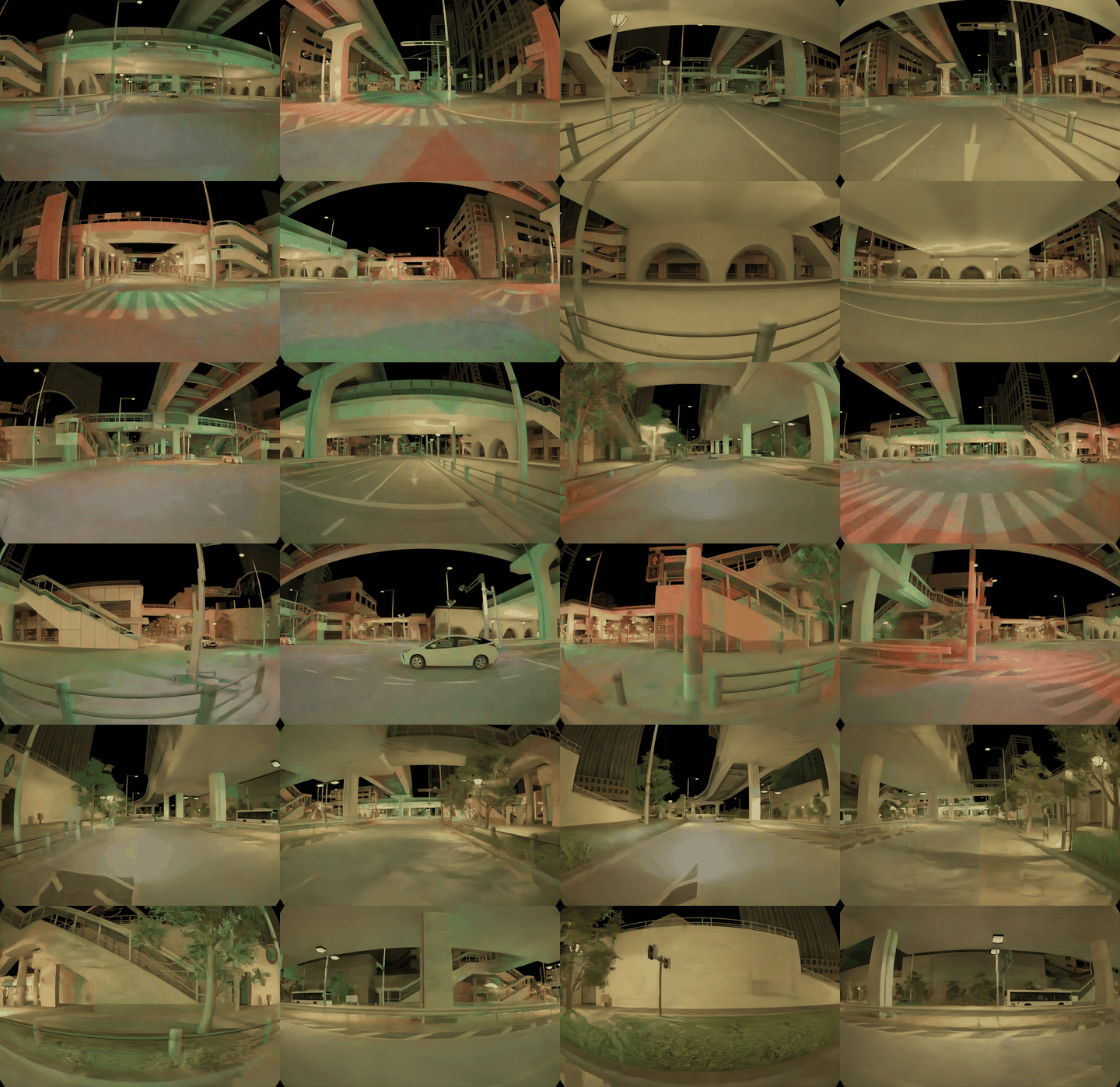
/// caption
The four cameras of vehicle_10000 (Daiba night_1), played frame-synchronized.
///
Timing
- 10 Hz, ~10-second clips → ~101 frames per variant.
- Frame timestamps run
0.0, 0.1, 0.2, …, 10.0s. - All sensors of all agents in a variant are time-synchronized.
See Scenarios & maps for the per-scenario catalogue and the detailed Daiba Station variant tables.